Call Toll-free
1-866-641-6900
Call Toll-free
1-866-641-6900 Kauai Ecotourism - Sea Turtles at Poipu Beach and Turtle Cove
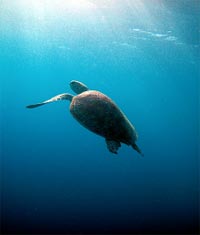 Photo
: Olve Hoegh-Guldberg,
Photo
: Olve Hoegh-Guldberg, U. of Queensland
Information
Hawaii’s green sea turtles, Honu (pronounced hoe-new), are named for the color of their body fat, which is green from the algae that they eat. They are primarily herbivorous.
These turtles migrate as far as 800 miles from their feeding areas along the coasts of the main Hawaiian islands to their nesting beaches in the Northwestern Hawaiian islands.
Turtles are reptiles
- They are cold-blooded
- They breath air
- Their skin has scales
Factors Affecting Population
- Marine debris - plastics are particularly harmful
- Habitat - coastal development and degradation
- Incidental catch - in fishing gear and discarded nets and lines
- Fibropapilloma - a recent phenomena causing the growth of large bulbous tumours. Turtles do not appear to recover once stricken and the exact cause is not known.
- Hunting – prior to the Federal Endangered Species Act of 1973 green sea turtles were killed in large numbers for food
- Protection - Thanks to government conservation measures and local citizen support, populations are now showing some recovery. Hawaii’s turtles are protected by Federal and International law with fines up to $100,000.00
How to help a Turtle
If you spot what appears to be a sick, injured or dead sea turtle stranded on land,
274-3521
241-6711 (Police dispatch)
651-7668 (Kauai Marine Conservation Co-ordinator)
- Remember all marine wildlife- sea turtles, seals, dolphins, and humpback whales require distance, quiet, and respect
- Report any wildlife distress or harassment
- Please keep dogs leashed and away from wildlife
It is illegal to ride a turtle.
Enjoy these natural treasures of Kaua’i. Your respect for their well-being and survival will ensure their presence for your next visit and for generations to come.
Call Toll free 1.866.641.6900 or email us
Fax 1.808.742.7620
Hanaka'ape Bay Turtle Sanctuary Organization (HBTSO) is a registered, non-profit organization located in Poipu, Kauai. Maintained by concerned citizens, it is dedicated to the establishment of a government-protected haul out area for the turtles there. Please become a member of HBTSO (membership is free) and sign their Letter of Support. Doing so will assist them in their efforts to secure official protection of this small but vitally important sanctuary for turtles (and please forward to all your turtle-loving friends).
http://www.turtlesanctuary.org/act/letter-of-support/